The Third Year of EWC, Starting from Paris
On Friday evening, the Seine splits eastward around the Île de la Cité. Right along this stretch, the sound of flowing water becomes more distinct, mingling with the relaxed conversations of French people lounging on the streets and a long-awaited gentle breeze, leisurely brushing past the long queues still waiting at the bar entrances along the riverbank. Though the line is long, people simply chat in small groups, as if the setting sun's descent is prolonged by the sheer coziness of those by the Seine.
After passing the corner and finally stepping into the bar, entry costs 16 euros. The setting sun is blocked outside, casting a dim, warm glow over everyone inside. Squeezing along the queue to the bar to order drinks, the bartender hands over a chip corresponding to the drink menu, which is then used to trade with the mixologist for tonight’s first drink: la-la-land.
At this moment, the night officially begins.
01 Searching for EWC in Paris
Walking down the stairs—barely wide enough for a single person—into the basement, an old piano, a drum kit, and a saxophone set the stage. The musicians shift from a few jazz numbers to a faster-paced blues; the performance is flawless, and the audience is fully immersed. Everyone holding a drink is compelled to sway, soul and alcohol briefly blending, while temperature and hormones steadily rise. Here, regardless of skin color, faith, wealth, past, or future, there is only rhythm.
A few Karmine Corp fans with the prominent "Orange" logo printed across their chests stand in the thick of the crowd. Their team just advanced to the semifinals and will challenge T1, the most decorated team in League of Legends history, tomorrow.
They come from the Paris Expo Porte de Versailles, located seven or eight kilometers south of the Île de la Cité, where Paris's old-town streets become slightly more spacious. If you spend 25 euros between July 6 and August 23, you can walk into an EWC 2026 knockout match on any Friday, Saturday, or Sunday to experience something more nerve-stimulating than alcohol and blues. At least for the Karmine Corp fans during the second week of EWC 2026, it is definitely so.
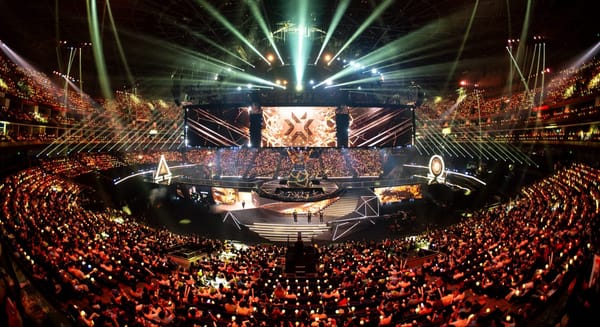
The roof of the Paris Expo Porte de Versailles is challenged countless times by the cheers of the local French audience, offering a completely different experience from the relatively reserved atmosphere in Riyadh. Similar to previous arrangements, this year’s EWC still features four main stages each week, crowning champions across four disciplines. The first week's main stage was dedicated to Valorant, while the second week featured League of Legends. The venue accommodates roughly 7,000 seats in total, alongside fans who bought all-access passes for other events standing in the aisles on either side of the stage, eyes locked on the shifts in game momentum on the screens.
The next afternoon, this crowd clad in blue truly transforms Porte de Versailles into Karmine Corp’s home turf.
Karmine Corp defeats T1 2 to 1. The exact moment the match ends, the players leap from their seats, and the sea of blue in the audience rises in unison. Those who were swaying to the saxophone by the Seine the night before are now shouting the name of the same team. The world champions fall before them. Cheers roll forward from the front of the stage to the back of the arena, echoing back along the exhibition hall’s steel frames and ceiling.
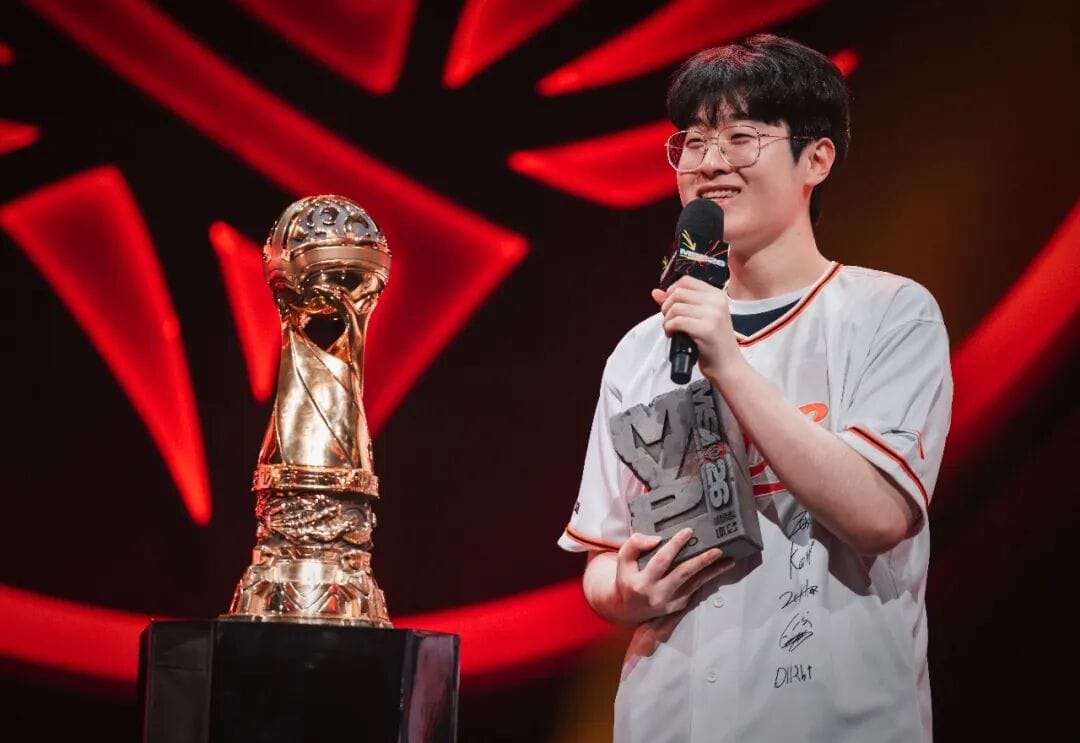
A day later, Karmine Corp loses 0 to 3 to Dplus KIA in the finals. The match quickly loses its suspense, yet the French audience stays until the very end; the blue flags remain raised, and the songs and chants never fade. The championship ultimately belongs to the Korean club DK, but the protagonists of that weekend remain Karmine Corp. Not a single person leaves during the award ceremony, and they still shower DK with cheers.
This is arguably the most easily felt change since the EWC arrived in Paris.
02 Giving EWC a New Voice
In Riyadh, past editions of the EWC were portrayed as an esports city built upon massive prize pools and elite players. Spectators had to make a dedicated trip out there, making the tournament itself the destination.
Upon arriving in Paris, it begins to integrate into the existing rhythm of a real city. Line 12 of the metro delivers tourists, office workers, and esports fans alike straight to Porte de Versailles. After the matches conclude, people in team jerseys disperse back into the bars, restaurants, streets, and along the banks of the Seine. They carry the lingering emotions of the match back into the Parisian night.
The relationship between the tournament and its audience thus becomes tangible. In nighttime Paris—around the Eiffel Tower, the Arc de Triomphe, and the streets near the Opera Garnier—you can spot Chinese fans wearing AG.AL or BLG jerseys, Korean fans wearing GenG or T1 jerseys, and even more French fans sporting KC jerseys.
Many spectators may not watch all seven weeks of competition from start to finish, nor are they necessarily familiar with all 24 titles. They might buy a League of Legends ticket because of Karmine Corp, alter their weekend plans on a whim because a French player entered the knockouts, or simply be dragged into the venue by a friend to wander casually between various stages.
The EWC provides such a space in Paris. Over seven weeks, 24 games make up 25 tournaments. Beyond the matches, there are Fan Fests, music performances, creator events, and showmatches. Compared to Riyadh, Paris knows how to party; just as Americans, compared to Qatar four years ago, truly understand how to monetize sports. Here, the EWC presents the complete form of a summer entertainment product that people expect. Esports matches sit at the center, surrounded by music, socializing, urban travel, and pop culture.
This experience will first alter how European audiences perceive the EWC, and then transmit this sentiment to China, South Korea, Indonesia, the United States, Brazil, and every major hub of esports fandom.
Over the past two years, many people’s introduction to the EWC started with the prize pool figures, Saudi funding, and the mildly tongue-in-cheek moniker "Petro-Cup." These impressions will not vanish overnight simply because the host city changed. However, once the tournament steps foot into Paris, a broader audience outside of Saudi Arabia gains the opportunity to make their own personal judgments. Validation often stems from this very point. It may not mean accepting everything behind the event, but it does mean the EWC is beginning to enter the lived experiences of European audiences.
This step was not originally part of the plan for 2026.
The first two editions of the EWC were both held in Riyadh, and the third was originally scheduled to stay in Saudi Arabia. Middle Eastern conflicts altered those plans, and organizers announced in May that the event would move to Paris, leaving a mere six weeks until the July 6 opening. From an industry practitioner's perspective, this was practically an impossible mission with zero groundwork, requiring adjustments to every single design plan. True to form, we saw the first week of EWC 2026 begin amidst some imperfections, but EWC’s "first international chapter" is far more significant than any superficial flaw in its execution.
Judging from the sites of the first two weeks, it has at least taken the first step. We can clearly see that a tournament founded by Saudi Arabia has thus acquired a live narrative comprised of a French home-court advantage and global club competition. This is far more effective than any promotional tagline about "globalization."
Globalization ultimately needs to be fulfilled by audiences in different places. Every city adds its own voice, habits, and emotions to the competition. Riyadh established the EWC; Paris is beginning to explain what else the EWC can become once it leaves Riyadh.
03 Another Kind of Live Scene Eight Thousand Kilometers Away
Over eight thousand kilometers away from Paris, a different kind of change is unfolding.
Compared to last year, the EWC has driven significantly more offline viewing events domestically. In early July, during the first week of the EWC, a massive screen broadcasting Valorant matches was set up inside Huogongdian at Pozi Street in Changsha. The 500-square-meter activity space was divided into a viewing area, a stage, and check-in zones. Gamers from various tactical shooter titles gathered here to watch EDG, XLG, and AG.AL, cheering together for Chinese players.
Ten days later, the event moved to Xian’anfang in Wuhan. Daytime featured pro-player showmatches, celebrity exhibition games, and interactive gaming, followed by group viewings of the League of Legends semifinals and finals in the evening. Meanwhile, the site offered trial experiences for other titles like Valorant and CrossFire, allowing fans to collect stamps, grab merchandise, meet players, or simply spend an afternoon with friends in the historic alleyways.
Most Chinese fans cannot afford to fly to Paris for a single weekend. The Chinese player parties organized in Changsha and Wuhan offered an alternative entry point into the EWC. They neither simply replicated the Paris stage nor compressed the event into a crowd staring at a giant screen for a few matches. Both Changsha’s Huogongdian and Wuhan’s Xian’anfang possess their own distinct urban personalities. Esports was embedded into local dining, nightlife, neighborhood atmospheres, and weekend lifestyles.
At this moment, the sense of purpose in watching matches is diminishing.
The "diminishing" here points to a more relaxed viewing dynamic. Spectators no longer need to prove beforehand that they are hardcore fans of a specific title. They might come just to see a player, to keep a friend company, to score some merch, or simply because they happened to walk by, heard the cheers, and stepped inside to check it out. This is an operating logic much closer to offline physical sports, and it is a necessary path for any sport to take that final leap into mass cultural consumption.
Match results remain important, but the match no longer carries the entire meaning. It is akin to people in Paris needing to go out for a drink on the weekend. You might head out for a specific bar’s band, but what you ultimately remember are the people you met, the drinks you had, and the vibe of that night. You might walk into an esports carnival for League of Legends, end up catching a CrossFire showmatch on the side, linger at the Teamfight Tactics area, and for the very first time learn what other lesser-known competitions a Chinese club is participating in over in Paris.
This element of serendipity is particularly crucial for multi-title esports tournaments.
Traditional single-game tournaments possess clear and solid fanbases. Their advantage is focus, but their boundaries are also quite rigid. The EWC places these titles on the same schedule, connecting the performances of different divisions through club overall standings. Clubs begin to consider participation layouts from a holistic ranking perspective. Content creators also step out of the comfort zones of single titles, trying out co-streams, player stories, and cross-game discussions. Audiences, driven by the success of Chinese clubs, linger a bit longer on genres they were previously unfamiliar with.
These three changes reinforce one another. The more events a club participates in, the more opportunities supporters have to encounter other competitions. The wider a creator's commentary coverage, the lower the barrier to understanding unfamiliar titles. As fans become willing to watch a few more games, the cross-game identity of clubs and the comprehensive value of the tournament become increasingly clear.
Once audiences actually watch a few matches, their focus naturally gravitates back toward the games themselves. New players, clubs, and community cultures begin to emerge. A gathering driven by a shared identity has the chance to evolve into a new, long-term interest.
The true significance of a multi-title tournament reveals itself here. It does not erase the differences between various games; difference itself is content worth exploring. Fighting game fans experience an emotional release within minutes, MOBA matches build suspense over tens of minutes, and shooters rely on split-second reactions to alter the tides. When spectators switch between games within the same tournament, they are also switching the ways they view the world and understand competition.
Thus, the EWC becomes a gateway to cultural consumption.
The work done by the EWC committee and its partners in China can also be understood from this perspective. Broadcasting delivers matches onto screens, while offline events embed the tournament into concrete urban lifestyles. When a tournament held far away in Paris can foster its own audience, events, and city memories in Changsha’s Huogongdian and Wuhan’s Xian’anfang, it has truly integrated into the domestic esports ecosystem. International tournaments, professional clubs, and mass consumption are thus linked together. The synergy between industry, events, and users—so often depicted in the narrative of China's esports industry development—finally gains a tangible, easily perceptible physical reality.
Returning to that Friday night by the Seine.
After finishing their drinks, Karmine Corp’s fans will still need to take the metro to Porte de Versailles the next day. They know who they support, and they know why they are shouting. As for everyone else down in the basement, someone might just ask what those team jerseys and wristbands mean. An understanding of the Esports World Cup perhaps begins with that very question.
From an observer's perspective, the EWC remains expensive, grandiose, and heavily stamped with Saudi resources. At the same time, by stepping outside of Riyadh, it has begun to become concrete. Concrete down to an affordably priced ticket, a weekend metro ride, a viewing party in an old street, and an audience member who originally only watched their favorite team stopping in front of another screen for the very first time.
True globalization probably happens precisely in moments like these.